Re-learning How to Learn
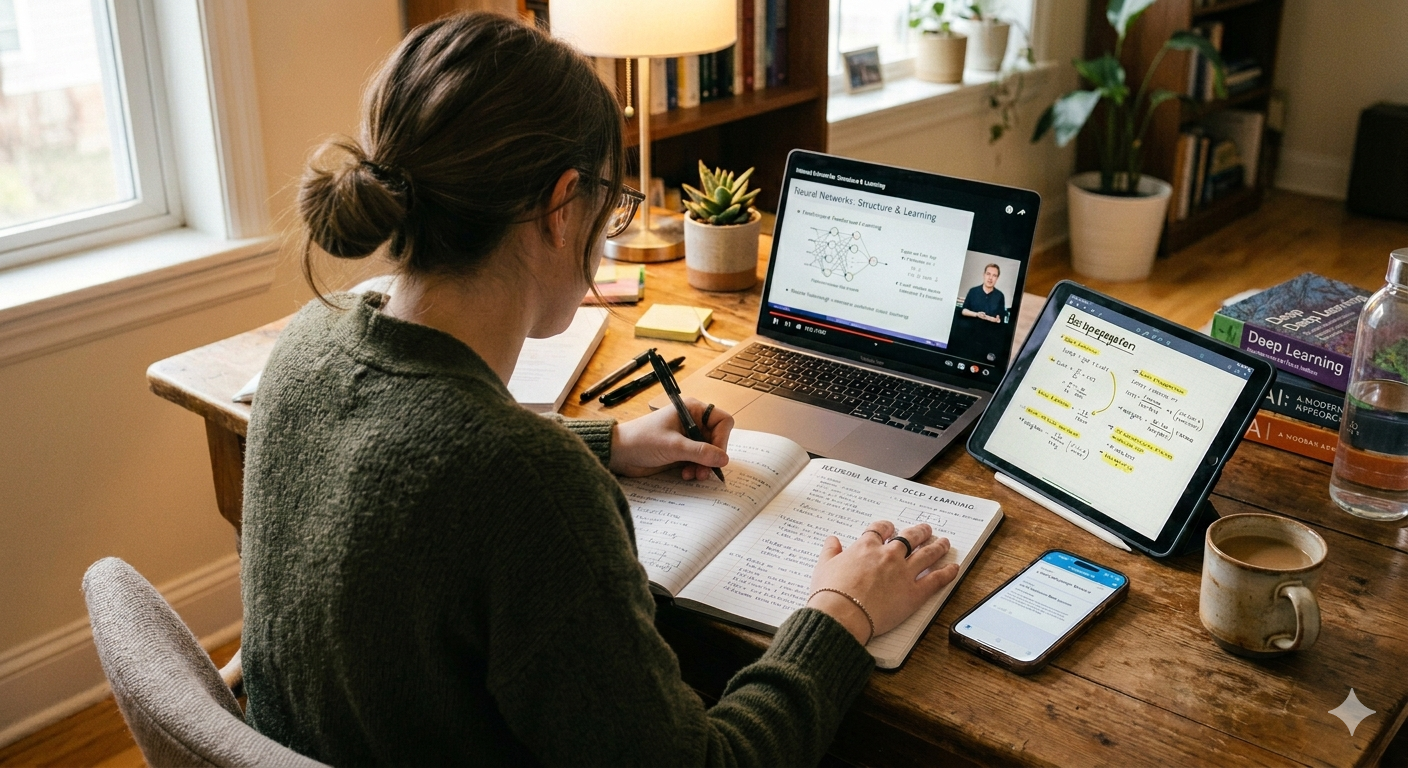
Returning to formal study in my 40s has felt like stepping out of a time capsule, one originally sealed somewhere in 2007 as I finished my second degree. Today, the landscape is unrecognizable when compared to back then. We've moved from an era of information scarcity to one of AI-driven synthesis. But as I navigate this new landscape, I've realized that not only the tools have changed, I have too.
2003 vs. 2026: From Milan to Bologna
In 2003, while I was reading for my first degree at the University of Malta, I longed to experience an international education. Back then, there were just a few ways to experience it and I chose Erasmus and Milan welcomed me. I remember leaving my parents' house, teary-eyed for the first time, to move to Italy for a semester. It was a life-changing, high-stakes leap into a different culture and a physical classroom, with lessons in another language, so far away from home.
Fast forward to 2026, and I am attending lectures with a university that is not in my country of residence. Those who know me are not surprised that it's still Italy — Bologna this time, but I'm attending from the comfort of my home in Malta through my laptop. I feel incredibly lucky to have access to such a high-calibre educational organisation while sitting comfortably at home. While I still get some "face time" during "smart weeks" where we travel for intensive sessions, the daily grind is digital.
It makes me wonder: if this is today, what will an Erasmus experience of tomorrow look like? Surely signing up for an extended reality (XR) session with a professor in a language you wouldn't usually understand, but are able to follow via real-time AI translation as if you were right there in the classroom, is not so far away.
The "Silver Surfer" Hand and the Quirky USB
Back in those early 2000s lectures, my "hardware" was a spiral notebook and the distinct curse of being left-handed. If you're a lefty, you know the struggle: the "silver surfer" hand. As you write, your pinky follows the pen, smudging the fresh ink across the page.
Because my lecture notes usually looked like a chaotic crime scene, my evenings were spent in a meditative ritual: rewriting them nicely or typing them out on my desktop computer at home. I also lived on a diet of endless photocopies. I carried literal "bricks" of paper in my backpack; journal articles and course packs. And let's not forget the pencil case filled with different coloured pens, highlighters and colour-coded sticky notes. Looking back at the volume of paper, I'm fairly certain the trees of the world love me a bit more in 2026.
My only high-tech indulgence was my USB stick. Being my quirky self, I couldn't just have a grey plastic rectangle; mine was always in some "cool" shape — a cute strawberry one day, a little green alien the next. It was my digital lifeline, used to shuttle my clean notes to the photocopy shops just outside university grounds, the owners of which knew us all by name, hoping I wouldn't lose it somewhere along the way.
The mobile phone I carried back then was good for little more than calls and texting. Today, my phone and tablet are as central to my studies as any laptop. Flashcards on my phone during a spare ten minutes, class notes on my tablet with a digital highlighter — the same colour-coded instinct, just without the dried-out pens.
The Brain-Hand Connection
Despite the sleek laptop and the borderless digital classroom, I haven't fully retired my analog habits. If you were to look at my desk during a live lecture today, you'd still find me clutching a pen, frantically filling pages with ink just like I did twenty years ago.
You might wonder why I still bother with the struggle of smudged notebooks. It seems almost counter-intuitive in 2026. But recently I was reminded of a concept that resonated deeply: the connection between the hand and the brain.
Writing isn't just about recording data; it's about registering it. There is a specific cognitive "click" that happens when the pen hits the paper, a tactile engagement that a keyboard, for all its speed, simply cannot replicate. Even now, I find myself reaching for a pen the moment I need to truly own a complex concept. The left-handed smudge is still there, of course, but I've realized that the silver-stained pinky is a small price to pay for the way the information anchors itself in my mind.
A Different Version of Me
The most humbling part of returning to study wasn't the technology; it was the realization that I am not the same person I was in 2007. In my 20s, studying was often a means to an end; a hurdle to clear between social engagements. I'll admit, there are significantly fewer (or none!) after-party study sessions these days. Mostly because my idea of a "wild night" has changed, but also because my 40-something brain requires a bit more focus (and sleep) to function.
Today, I study with a level of attention I simply didn't possess back then. Because I understand the world so much better now, the material has context; it has weight. I'll admit, I go down academic rabbit holes more than I dare to confess, but I am enjoying the process infinitely more. I'm not just trying to pass; I'm trying to connect.
My 2026 "Sidekick" Workflow
To support this more curious, intentional brain, I've had to relearn how to learn. My workflow moves through three stages:
The Intake: I feed lecture transcripts and slide decks directly into AI, then generate infographics, quizzes, and flashcards to build a baseline understanding — flashcards I'll later revisit on my phone whenever I have a spare few minutes — alongside a structured outline for my study notes based on my own predefined templates.
The Refinement:These notes are then refined again — I use Claude, though some colleagues use ChatGPT. I'm strict here: I don't allow it to fill in the gaps, keeping the content tethered to the source material. I want my notes factual and correct, not creative.
The Simulation: Finally, I generate mock exams using my refined class notes. The study programme has also provided us with a virtual AI agent that offers additional insights into the topic content and guidance for our exams.
The Final Synthesis
The transition from the manual era of 2005–2007 to the AI era of 2026 isn't just about efficiency; it's about the evolution of the student. By offloading the administrative side of studying; the organising, the searching, the transcribing, I finally have the mental space to engage with the material on my own terms.
The left-handed smudge is still there, a small, messy reminder of that hand-to-brain connection that keeps me grounded even as the world around me goes virtual. I don't have the strawberry USB stick anymore, and I've traded physical photocopies for digital prompts, but the goal remains unchanged. In my 40s, I've finally learned that real studying isn't about how much you can carry in your backpack or memorise in your brain; it's about how deep you're willing to go.